After adding the filter, you can go to the Game Filters page in the same Filters window to edit the filter properties.
The added filter will be located under the Non-Adjacent Numbers Distribution group of all filters, with its value in the Property cell set to 1 as
Use
If selected, the filter will be used to apply filtering.
Action
Sets the filter action applied by the filter to determine the final outcome when filter's condition is met.
You can choose to accept or reject numbers
Select your preferred option from the drop-down menu in the Action column.
- When you choose Accept action then:
- When you choose Reject action then:
Property
Sets the filter for analyzed numerical values; you can configure it here:
This filter does not have any property to configure; instead, it only displays:
You can adjust the filter property here to select a different number for analysis by choosing another option from the drop-down combo box.
You can modify the filter property to choose a different number for analysis by either using the spin edit control or typing the number directly into the property cell.
Number Main Type
Sets the filter for Number Main Type, allowing you to filter numbers by their type.
If the main type is set to ALL, then all numbers are included regardless of their type.
Please refer to the Filters - Types of Numbers topic for more information about filtering numbers by their type.
You can select the type of number you want to filter by from the drop-down menu.
Number Subtype
Displays or sets the filter for Number Subtype, allowing you to filter numbers by their type.
If the sub type is set to ALL, then all numbers are included regardless of their sub type, only those set in the Number Main Type property are included.
Essentially, you can filter numbers by their occurrences in various types of number configurations.
You can select the type of number you want to filter by from the dropdown menu.
Value
Sets the condition value for the filter to be satisfied.
You can set here for example:
Range
Displays or sets the filter's condition range value, used only when the filter's condition is set to a Range of Values.
Condition
Filter conditions you can apply to meet the filter Value option criteria .
You can select a filter condition from drop-down list combo box one of the following conditions:
Non-Adjacent Numbers – Filter Conditions
Any Number
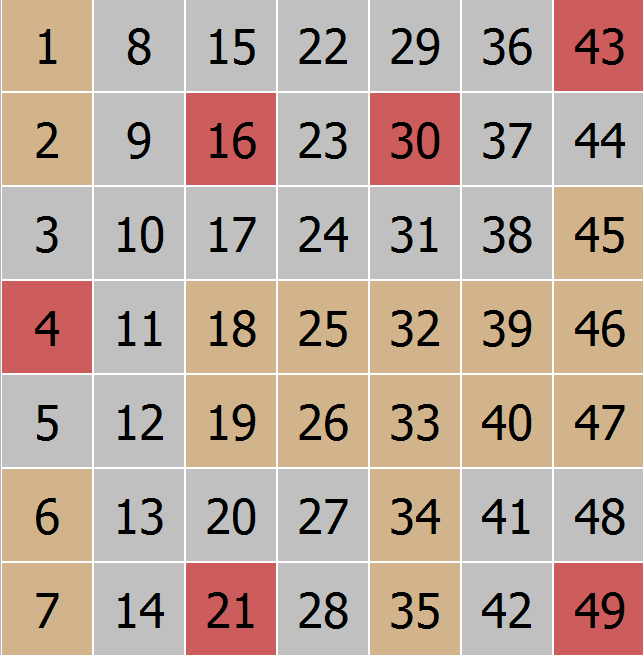
This condition allows numbers that are not adjacent—numbers that do not appear next to each other in a geometric pattern on the ticket—to be accepted or rejected without verifying other types, and no additional properties need to be configured.
Reject: Non-adjacent numbers in the current layout will be excluded from generated tickets, and any wheel system combination containing such numbers will be rejected.
Accept: Non-adjacent numbers in the current layout will be included into generated tickets, and any wheel system combination containing such numbers will be accepted.
Equals Filter Value
The filter will only meet its criteria if the quantity of numbers matched in non-adjacent positions equals the specified value.
Reject: Generated tickets or wheel system combinations will not include selections where the exact specified numbers are matched in non-adjacent positions.
Accept: Generated tickets or wheel system combinations will include only selections where the exact specified numbers are matched in non-adjacent positions.
Higher than Filter Value
The filter will only meet its criteria if the quantity of numbers matched in non-adjacent positions is greater than the specified value.
Reject: Generated tickets or wheel system combinations will not include selections where numbers matched in non-adjacent positions exceed the specified value.
Accept: Generated tickets or wheel system combinations will include only selections where numbers matched in non-adjacent positions exceed the specified value.
Lower than Filter Value
The filter will only meet its criteria if the quantity of numbers matched in non-adjacent positions is less than the specified value.
Reject: Generated tickets or wheel system combinations will not include selections where numbers matched in non-adjacent positions are below the specified value.
Accept: Generated tickets or wheel system combinations will include only selections where numbers matched in non-adjacent positions are below the specified value.
Range of Values
The filter will only meet its criteria if the quantity of numbers matched in non-adjacent positions falls within the specified range.
Reject: Generated tickets or wheel system combinations will not include selections where numbers matched in non-adjacent positions are within the specified range.
Accept: Generated tickets or wheel system combinations will include only selections where numbers matched in non-adjacent positions are within the specified range.
|